

Pentagon Looks to Autonomous Cargo Ships for High-Risk Resupply Missions
Patriot Brief
• Pentagon plans autonomous cargo ships to operate in contested coastal waters.
• Robotic vessels would carry nine tons and self-scuttle if capture looms.
• Proposal reflects shift toward expendable, resilient logistics in future conflicts.
The U.S. military is quietly preparing for a future where even supply ships may have to fight to survive.
A new solicitation from the Defense Innovation Unit outlines plans to develop autonomous cargo vessels capable of delivering supplies into contested waters — and sinking themselves if necessary to avoid capture.
The request makes clear that the Pentagon sees logistics, not just firepower, as a growing vulnerability. The Department of Defense “faces a littoral contested logistics challenge,” the document warns, pointing to increasingly distributed operations in austere coastal regions where supply lines are exposed to threats across multiple domains.
In plain terms, the military expects that in a future conflict, moving fuel, ammunition, food, and equipment near hostile shores will be dangerous work. Traditional logistics ships — large, slow, and highly visible — present inviting targets. The proposed solution: smaller, lower-profile, and expendable robotic freighters.
The vessels would need a minimum cargo capacity of nine tons, far smaller than commercial container ships that carry tens of thousands of tons. They must be compact enough to be transported by a commercial tractor-trailer, suggesting a modular platform that can be deployed quickly.
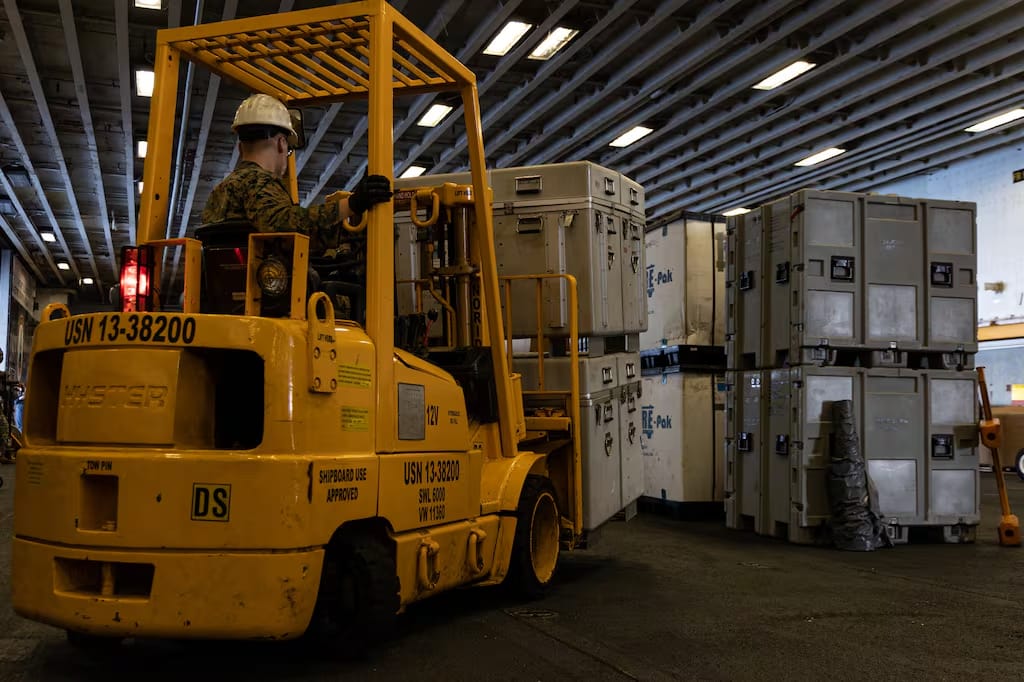
Cargo would include standard pallets, Pallet Containers (PALCONs), and Joint Modular Intermodal Containers (JMICs). Each ship must carry six 3,000-pound JMICs or two heavier containers. The idea appears to be flexibility — a maritime workhorse capable of moving essential supplies between ships, ports, and shore facilities.
The vessels must travel at least 12 knots while fully loaded and operate in sea state 5 conditions, meaning waves up to 13 feet. Range requirements call for 1,000 to 2,000 nautical miles without refueling. While not fast by commercial standards, the emphasis is on endurance and survivability.
Autonomy brings additional technical hurdles. The Pentagon anticipates GPS jamming and degraded communications in contested waters. As a result, these vessels must operate with assured Position, Navigation, and Timing systems in denied, degraded, intermittent, and limited communications environments. They must be capable of passive sensing under emissions control conditions and allow reprogramming for new destinations while underway.
At the same time, human operators must retain the ability to remotely control the vessels when needed.
Perhaps the most striking requirement is security. The ships must be resistant to tampering and include the capability to be remotely scuttled — deliberately sunk — to prevent hostile capture. In other words, if interception becomes inevitable, the vessel would destroy itself rather than provide an adversary with cargo or technology.
The proposal reflects a broader shift within the Department of Defense toward autonomous systems across air, land, and sea domains. Unmanned aircraft have already transformed reconnaissance and strike operations. Autonomous surface vessels may soon do the same for logistics.
In contested maritime environments, logistics can determine whether forces remain combat effective. By reducing reliance on large, crewed ships and introducing smaller, expendable platforms, planners appear focused on preserving operational reach while limiting risk to personnel.
If the program moves forward, these robotic freighters could become a quiet but critical component of future supply chains — delivering cargo where traditional ships might hesitate to sail, and disappearing beneath the waves if necessary to keep that cargo out of enemy hands.
Source: Military Times