


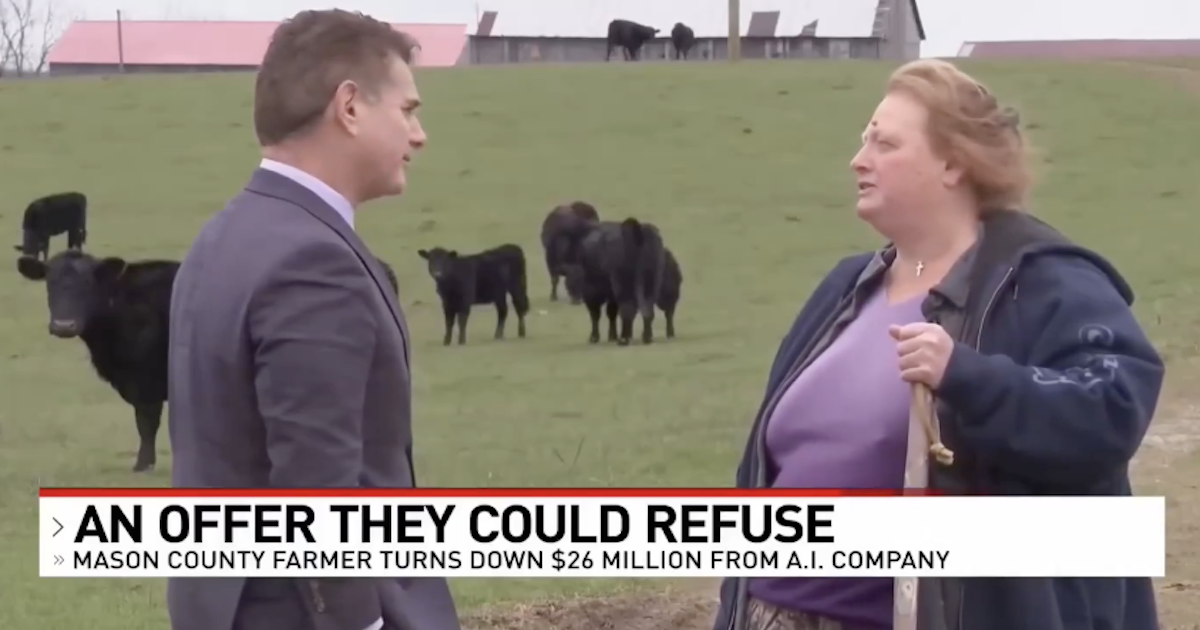
- What Happened: Ida Huddleston, 82, and her daughter Delsia Bare turned down a $26.5 million offer from an unnamed Fortune 100 company to sell part of their 1,200-acre farm near Maysville, Kentucky for a data center.
- Why It Matters: The Bare family has farmed this land since the 1860s, feeding the country through the Great Depression. AI data centers can consume as much electricity as a mid-sized city and hundreds of thousands of gallons of water daily. The U.S. lost 2.5 million acres of farmland and 15,000 farms in 2025 alone.
- Bottom Line: Some things are worth more than money. This family knows it. America needs more people like them.
When men representing an unnamed Fortune 100 tech company showed up at Delsia Bare's door last April with an offer of $26.5 million for part of her family's Kentucky farmland, her answer was immediate.
"If it's my way, I'll stay and hold and feed a nation. $26 million doesn't mean anything."
Bare and her mother, Ida Huddleston, 82, own roughly 1,200 acres of prime agricultural land near Maysville in Mason County, Kentucky. The unnamed company, representing AI interests, offered $60,000 per acre for Huddleston's 71 acres and $48,000 per acre for Bare's 463 acres, pushing the total to $26.5 million. In an area where farmland typically sells for a fraction of that price, the offer was roughly 10 times market value.
They still said no.
NEW: Kentucky family rejects $26 million offer to convert part of their farm into a data center despite the offer being about 10 times the going rate for farmland in the area.
— Collin Rugg (@CollinRugg) March 24, 2026
"If it's my way, I'll stay and hold and feed a nation. 26 million doesn't mean anything."
"As long as… pic.twitter.com/eK9gTXmwq0
The family's connection to this land runs deeper than any dollar figure. Parts of the Bare farm have been in the family since the 1860s. They worked it through the Great Depression, raising wheat that helped keep bread lines running across America when people had nothing else. Multiple generations have lived, worked, and died on this soil.
"As long as I'm on this land, as long as it's feeding me, as long as it's taking care of me, there's nothing that can destroy me if I've got this land," Bare said, comparing her attachment to Scarlett O'Hara's bond with Tara in Gone With the Wind.
Huddleston was blunter about what she thinks of the whole operation. "What they've proposed and carried on, it's not a business deal, it's mind harassment," she said. She is equally skeptical of the company's promises of 400 full-time jobs and 1,500 construction positions. "You won't have over 50 and they won't even be here at this building when it's said and done," Bare predicted. As for the company's assurances overall: "I say they're a liar, and the truth isn't in them. It's a scam."
A mother and daughter in Kentucky have rejected multimillion-dollar offers for their land, offers made by an anonymous tech company trying to build a data center.
— More Perfect Union (@MorePerfectUS) March 11, 2026
Ida Huddleston has turned down $4,260,000.
Her daughter turned down $22,224,000.
Video: @LEX18News pic.twitter.com/O9OB7QlnEB
The refusal to publicly identify the Fortune 100 company behind the project is a major red flag for the family. "When they will not reveal who they are, that's a major player in what you're going to do with the rest of your life," Bare said.
Huddleston sees the bigger picture. "They call us old stupid farmers, you know, but we're not," she said. "We know whenever our food is disappearing, our lands are disappearing, and we don't have any water, and that poison. Well, we know we've had it."
The Huddlestons are not alone. Neighboring farmers Andy Grosser and his father Timothy rejected nearly $8 million for their land in the same project area. In Pennsylvania, 86-year-old Mervin Raudabaugh turned down a $15.7 million offer for his 261-acre farm outside Harrisburg, instead selling development rights to the Lancaster Farmland Trust for under $2 million to guarantee the land stays farmland forever. "It breaks my heart to think of what's going to take place here," Raudabaugh said. "The American farm family is definitely in trouble."
He is not wrong. The USDA reported the United States lost 2.5 million acres of farmland and 15,000 farms in 2025 alone, with not a single state adding farms. The American Farmland Trust estimates the country loses roughly 2,000 acres of agricultural land every single day to development. AI data centers consume as much electricity as a mid-sized city and hundreds of thousands of gallons of water daily for cooling. Projections show U.S. data centers could claim up to 12% of the nation's total electricity by 2028.
The Mason County Fiscal Court is still reviewing the project, with public meetings scheduled for March 25 and 26. Developers have already struck deals with willing sellers and filed zoning requests to rezone more than 2,000 acres of agricultural parcels. A county ordinance recently increased residential setbacks from 500 to 750 feet, signaling the accommodation of industrial-scale development.
But Ida Huddleston and Delsia Bare are not moving.
"I said I don't want your money, I don't need your money," Huddleston told the developers. "But I do feel sorry for everybody around us. They're gonna be affected by it."
In an age when everything has a price, this family is a reminder that some things should not.