It was supposed to take about an hour.
On July 30, nine members of one family climbed into a 20 foot skiff in Chuuk, one of the four states of the Federated States of Micronesia, for a routine crossing between the islands of Murilo and Ruo. They were on a supply run. The oldest of them, Tedwinson Paul, was 31 and had made the trip before.
They did not come home that day, or that week, or that month.
The Search That Ended Too Soon
Somewhere on the way, a storm hit and the boat ran out of fuel, according to reports from the Australian Broadcasting Corporation and The New York Times. The skiff was pushed out into the open Pacific.
When the boat failed to return, Arthur Irons II, a Chuuk state official, alerted the national government. The U.S. Coast Guard, which helps patrol the region, launched a search with help from U.S. Navy and Air Force aircraft.
Searchers covered about 25,000 nautical miles. After 10 days with no sign of the boat, the Coast Guard suspended the search on August 9.
The family was still alive, and still drifting.
Rainwater, Birds and Turtles
What followed was nearly 100 days at sea.
The passengers drank rainwater, Irons told The New York Times. A nurse and a clerk on the island where they eventually landed said the group caught birds and turtles to eat.
They saw ships and planes in the distance and waved for help. Irons said the boat was simply too far away for anyone to notice.
Not everyone made it. Four of the nine, including a child, died during the voyage. The survivors had to commit their bodies to the sea.
Irons, who spoke with Paul several times after the rescue, said the eldest survivor told him through tears on a video call that he was grateful to be alive but carried guilt over the relatives who were not.
The Island on the Horizon
Around the end of October, after drifting more than 3,000 miles east, the survivors finally saw land.
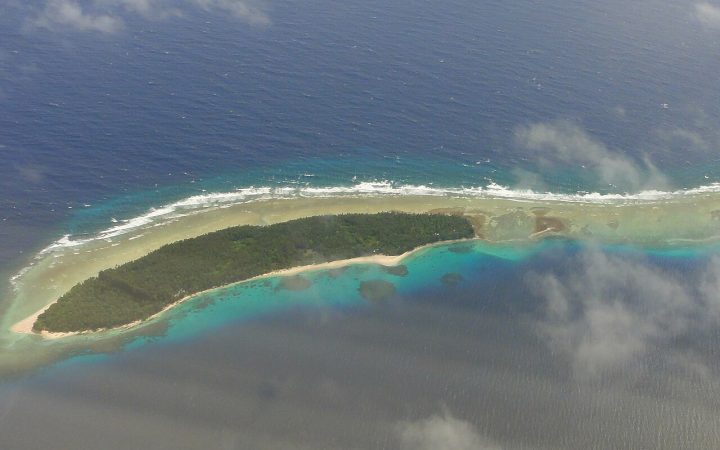
It was Tabuaeran, also known as Fanning Island, a remote coral atoll in Kiribati’s Line Islands, deep in the central Pacific. The next day their skiff ran aground on the reef and broke apart, The New York Times reported.
Then came the moment that has made the story travel around the world.
It was a Sunday morning. The survivors, three men and two 13 year old boys, heard church bells ringing and followed the sound into the village.
They were unclothed and so weak they could barely walk. At first, villagers thought the strangers lurching toward them were drunk, the island’s nurse, Baukin Raimon, told the Times.
The pastor stopped the church service to see what was happening. Soon the village had taken all five into its care.
Slowly Coming Back
Kaotitaake Rakoroa, the local member of parliament, told the ABC the group was cared for by the pastor of the island’s Uniting Church and treated by medical staff on the island. He urged that they be flown as soon as possible to Kiritimati Island, the nearest urban center, for more treatment.
The nurse gave them intravenous fluids. All five were badly dehydrated and malnourished. By the following Tuesday, she said, the men could stand on their own, though the two boys were still too weak to move without help.
Back in Chuuk, the governor’s office thanked God for the five who were found and said it continued to pray for the four who were lost. Officials in Micronesia and Kiribati began working on the paperwork to bring the survivors home.
“It’s Like a Routine”
For people who live in the region, the story is as familiar as it is astonishing.
Small boats with engine trouble or no fuel can be carried for weeks across the Pacific, and without safety gear a minor problem can turn deadly, Irons said. He was once stranded at sea himself for several days after his own boat sank in 2016.
“It’s like a routine, I’m sorry to say,” he told the Times.
This time, five people came back from a trip that was supposed to last an hour. They owe the last steps of it to a village that was simply ringing its bells for Sunday service.
Photo: The lagoon entrance at Fanning Island (Tabuaeran), Kiribati. This is a general view of the island, not a photo of anyone in this story. Photo by Dr. James P. McVey, NOAA Sea Grant Program, public domain, via Wikimedia Commons.
Sources
- ABC News (Australia), rescue report (November 2, 2026): abc.net.au
- The New York Times, via Brisbane Times (November 6, 2026): brisbanetimes.com.au
- The New York Times, via Hawaii Tribune Herald (November 5, 2026): Hawaii Tribune Herald
- Associated Press, rescue report (November 2026): apnews.com
- The Telegraph, rescue report (November 2, 2026): telegraph.co.uk
- RNZ, rescue report (November 3, 2026): rnz.co.nz
- People, survivor details (November 6, 2026): people.com